
Edna Mae’s Sour Cream Pancakes
…
 These pancakes…aren’t just any pancakes.
They’re…wait for it…
They’re Edna Mae’s Sour Cream Pancakes!
Of course, you probably already figured that out based on the title of this post.
I’ve always been really great at building suspense.
Or not.
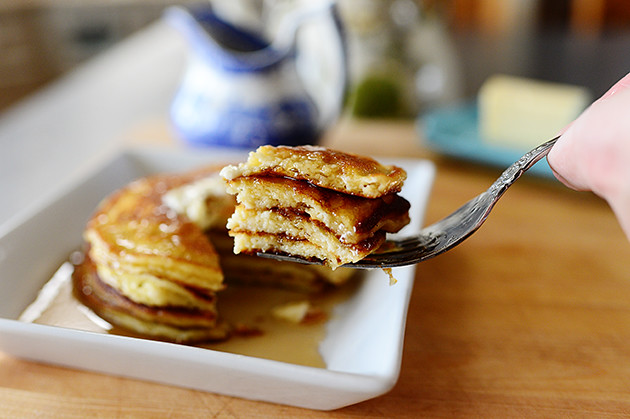
 I love this recipe so much, I put it in my first cookbook. It’s turned out to be one of the most-enjoyed recipes in the book.
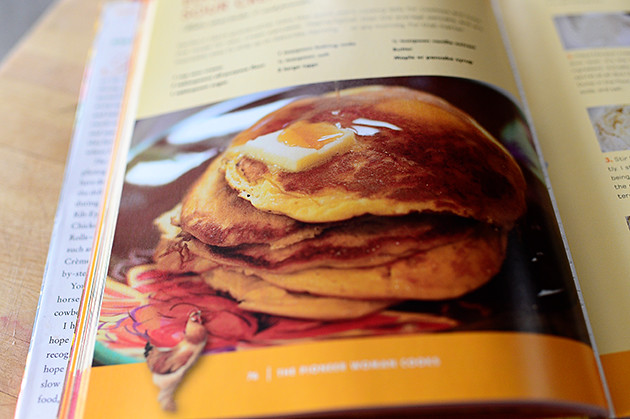 Recently, I was sharing with Edna Mae (she’s Marlboro Man’s precious grandmother) some of the nice things people have told me about her delicious pancakes, and it dawned on me that I’d never, in the six years since I first started posting about cooking, posted it here on my website.
What an outrage!
What an oversight!
INCONCEIVABLE!
Well, I’m righting that wrong right now. Alright? Righty-Oh.
Right on.
I’ll stop now.
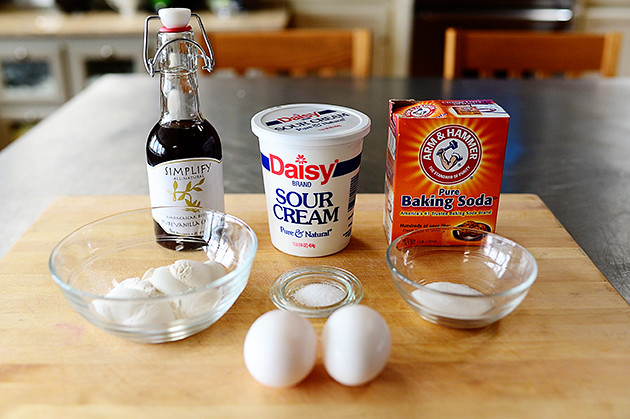 The ingredients couldn’t be more simple: Sour cream, flour, baking soda, sugar, salt, eggs, and vanilla!
 Sour cream is the star of the show.
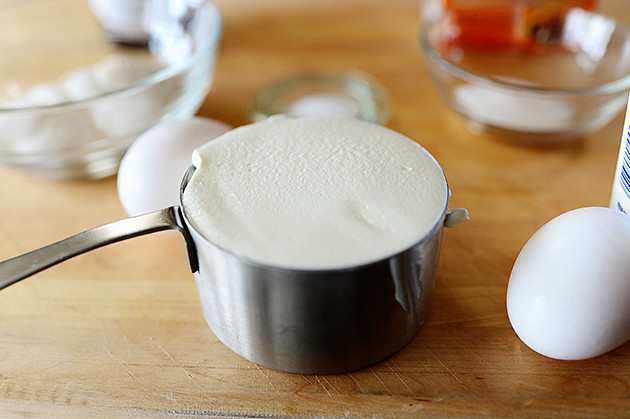 Measure a cup…
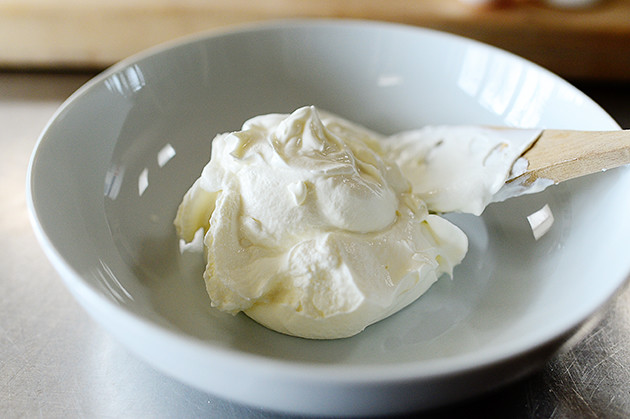 And throw it into a bowl.
 Sprinkle in the flour, and it is at this time that I’ll point out that aside from the comments I hear from people who love these pancakes after they make them, I receive quite a few questions from people before they’ve made them for the first time.
“That can’t possibly be the right amount of flour…can it?”
Yes! It’s correct, baby! That’s what makes these glorious little wonders so…well, wonderful. They’re not weighed down with flour; they’re light and a decidedly different texture. You’ll be able to tell from the first bite.
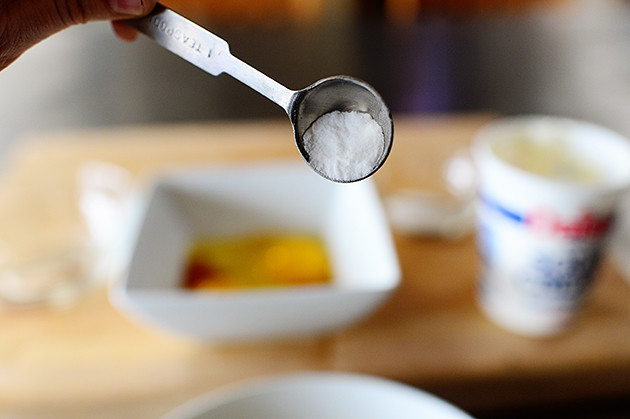 Next, add baking soda…
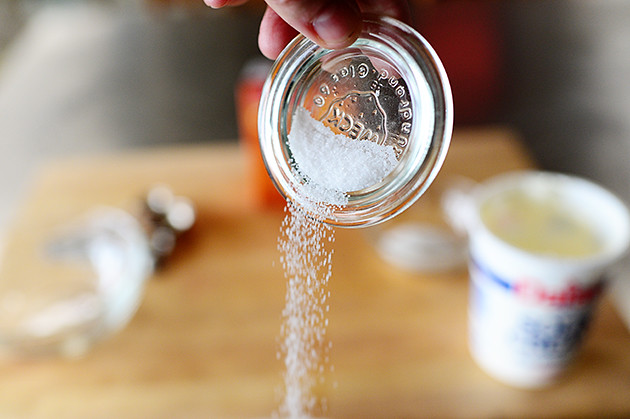 Salt…
Salt…
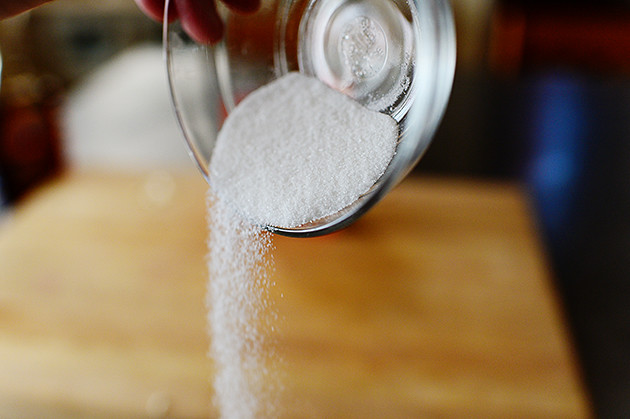 And sugar.
A note on the sugar: Edna Mae’s original recipe calls for 1 tablespoon. I sometimes do two or three, because it makes the pancakes a little sweeter…but if you prefer all the pancake sweetness to come from the syrup you pour over the top, go ahead and keep it at one.
I realize that made no sense. Sorry.
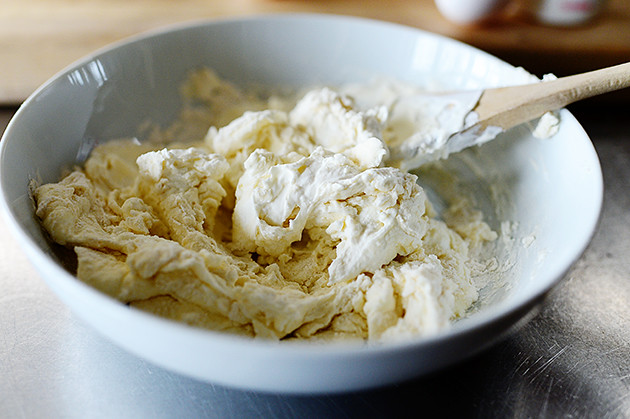 Now, stir the sour cream and the dry ingredients until it just starts to come together.
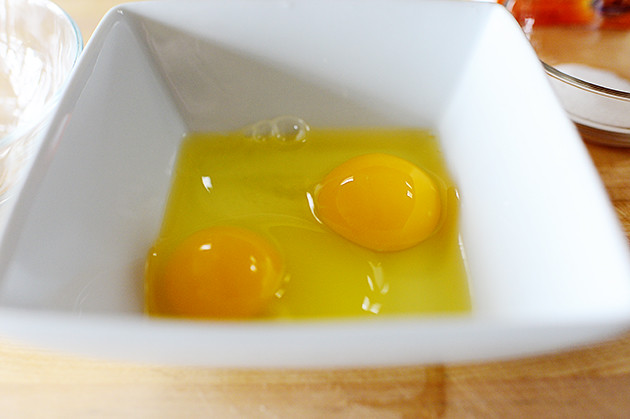 In a separate bowl, crack 2 eggs…
 Add a little vanilla…
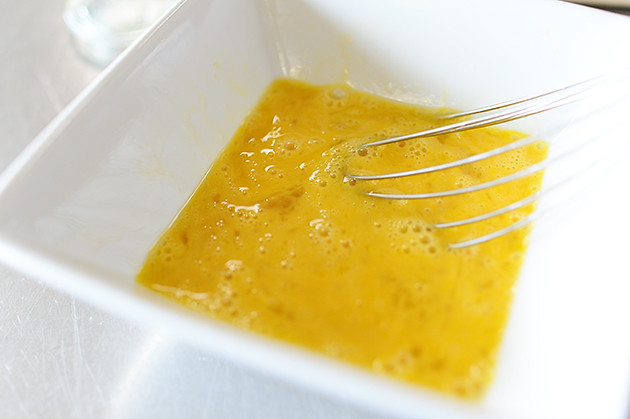 And whisk it together until totally combined.
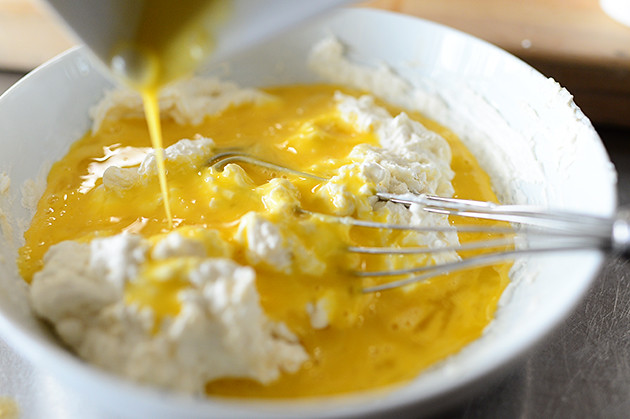 Pour it into the bowl with the sour cream mixture…
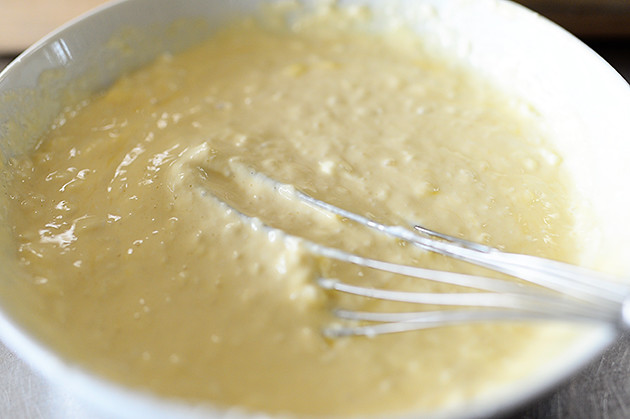 And whisk it until it just comes together. You don’t need to beat it to death, and you shouldn’t be concerned with lumps—that’s what it should look like.
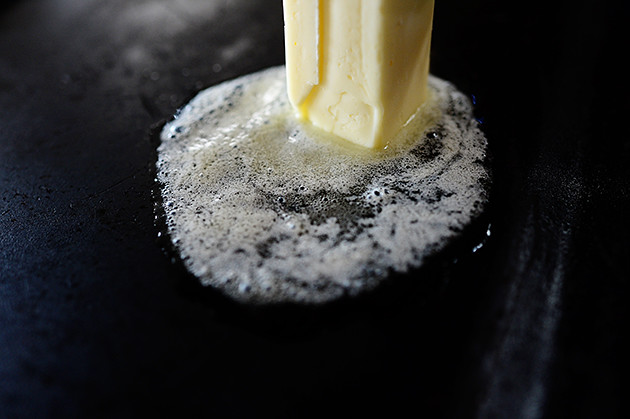 To fry ‘em up, smear a whole bunch of butter on a griddle or skillet over medium-low heat (get the griddle totally heated before you do.)
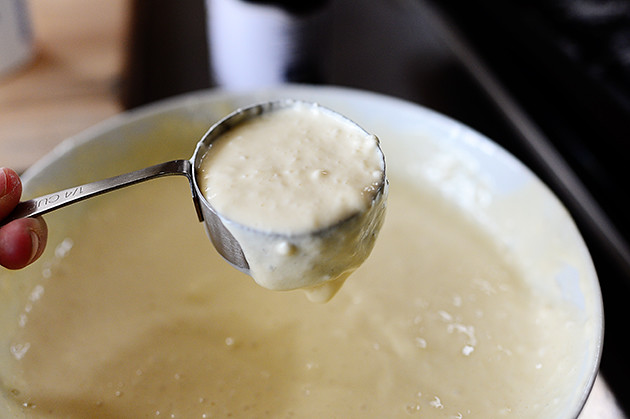 When the butter’s sizzling, grab 1/4 cup of batter…
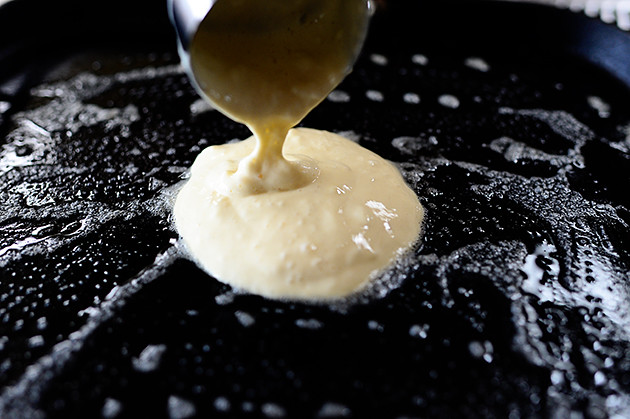 And pour it on.
 Let it cook for 2 minutes or so, and when the sides look like they’re starting to set and bubbles just start to form…
 Flip it over and let it cook for another 2 minutes or so.
 Keep going with the rest of the batter until the pancakes are “done,” but note that they’ll be a little softer than regular pancakes. As long as both sides are nice and deep golden brown, they should be good to go!
 So here’s how I roll with pancakes.
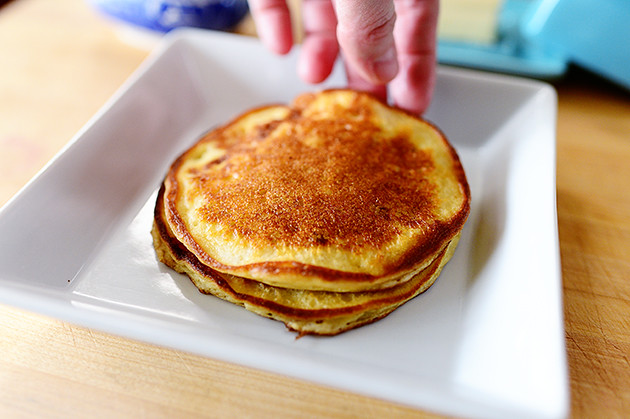 Keep going…
 Keep going…
 Keep going…
 Okay. I think I’ll stop there.
 Warm syrup is a must. A requirement of life. A mandate.
 Lean in for a minute. I wanna tell you a secret.
Come closer…
Come closer…
 You’re going to absolutely love these. They’re light but decadent, different but familiar. Lemme know how you like ‘em.
 Here’s the handy printable.
Have a wonderful Monday, everyone!
RecipeEdna Mae’s Sour Cream Pancakes
- Prep Time:
- Cook Time:
- Difficulty:
- Easy
- Servings:
- 2
 Print Recipe
Ingredients
- 1 cup Sour Cream
- 7 Tablespoons All-purpose Flour
- 2 Tablespoons Sugar
- 1 teaspoon Baking Soda
- 1/2 teaspoon Salt
- 2 whole Large Eggs
- 1/2 teaspoon Vanilla Extract
- Butter, For Frying And Serving
- Warm Syrup, For Serving
Preparation Instructions
In a small bowl, whisk together eggs and vanilla. Set aside.
In a separate small bowl, stir together flour, sugar, baking soda, and salt.
In a medium bowl, stir together the sour cream with the dry ingredients until just barely combined (don't overmix.) Whisk in the egg mixture until just combined.
Heat a griddle over medium-low heat and melt some butter in the pan. Drop batter by 1/4 cup servings onto the griddle. Cook on the first side until bubbles start to form on the surface and edges are starting to brown. Flip to the other side and cook for another minute. (Pancakes will be a little on the soft side.)
Serve with softened butter and syrup.
Posted by Ree on April 8 2013

What porn do they watch in the Vatican?
…

TorrentFreak's been looking at the BitTorrent video-downloading from the small pool of downloaders in Vatican City, and they've reported in with the Vatican's favorite pornography:
In the interests of science we researched each of the titles (including the curiously named RS77_Episode 01) and discovered that downloaders in the Vatican have one or two unusual ‘niche’ interests. We won’t link to our discoveries here, but feel free to do your own ‘research’ using the titles shown above. There isn’t a commandment that covers these films directly, but some might argue there should be.
TorrentFreak couldn’t find a priest prepared to make a comment and apparently the Pope is “busy” today. On a Sunday?
Priests Watch DVD Screeners While Pirates Download Filth in the Vatican

Street Artist Roadsworth Transforms the Streets of Montreal into a Visual Playground
…


In 2001 artist Peter Gibson began a guerrilla street art campaign to encourage the city of Montreal to build more bike lanes. What began as a project borne of activism eventually became an art project that continues to this day. Assuming the name Roadsworth stating, “where Wordsworth is a poet of words, Roadsworth is a poet of roads,” the artist has cleverly modified roads, sidewalks, parking lots and any other publicly visible asphalt surface he can transform with paint. If you want to learn more, the artist recently took a moment to share some thoughts with My Modern Met and you can see much more of his work on his website.
Update: Colossal reader Roula adds via Facebook: The first image “is a visual translation of ‘nid de poule‘—chicken nest, which is the quebecois expression for potholes.”
20+ Cheatsheets & Infographics For Photographers
…
We love cheatsheets as one can refer to them and make quick amendments to better our skills. Since many loved our last compilation of cheatsheet for designers, we’ve decided to compile another set of cheatsheets, this time for photographers.
Amateur photographers, and even pros can easily benefit from these cheatsheets as it is a resource for fresh and new ideas. We’ve scoured the Web and have found a wide variety of cheatsheets covering various aspects of photography and catering to the many levels of skills and interest of anyone who calls themselves a photographer.
Most of the pictures you see here are cropped for a nice fit, so remember to click on the links to check out the entire cheatsheet or infographic. Some of them are really long and can give you a ton of worthwhile information that you really can’t do without.
Recommended Reading: Five Vital Black & White Photography Tips


3 Ways to Affect Depth of Field

What Your Camera Captures At Every Lens’ Focal Length


Portrait Lighting For Home Studio

Nikon vs Canon: Shooting Modes


More Photography Resources
Here are more (but wordy) resources to help in certain photography situations. The following also includes keyboard shortcuts for Adobe Lightroom and Apple Aperture together with a few other cheatsheets for certain DSLR models.

Wedding Photography Cheatsheet


Landscape Photography Cheatsheet


Best Shutter Speeds For Every Situation

Adobe Lightroom Keyboard Shortcuts – Windows & Mac

Apple Aperture Keyboard Shortcuts

Canon Memory Card Compatibility

Related posts:
Cody Cobb. Some of the best photographs I’ve ever seen by...
…


Some of the best photographs I’ve ever seen by Cody Cobb (On Tumblr):


carunsa: tumblingwithstyle: “oh, there are pictures.. I keep...
…

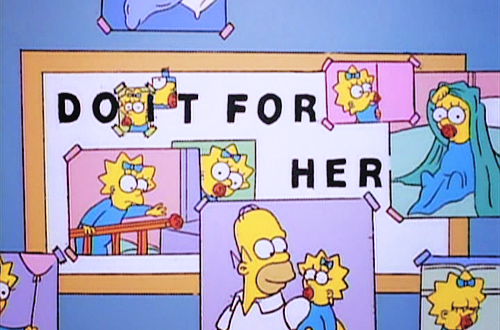

“oh, there are pictures.. I keep them where I need the most cheering up.”
For those who don’t know the story behind this:
Before Maggie was born, Homer Simpson worked at the Nuclear Plant because he needed the money to pay for all the debt. Once Homer Simpson finally payed the debt, he quit his job to work at his dream job at the bowling alley. When Homer Simpson found out that Marge was pregnant with Maggie, he became depressed that he had to quit his job at the bowling alley because the salary couldn’t support them. When Homer Simpson begged Mr. Burns for his old life back, he put a plaque that reads “Don’t Forget: You’re Here Forever.” When Maggie was born, Homer instantly fell in love with her. When Lisa asked Homer where did all Maggie’s baby pictures went, Homer explains that he keeps it where he needs it the most
A Primer on Krav Maga: The Combative System of the Israeli Defense Forces
…

I can’t remember how I first heard about Krav Maga, but I do remember being immediately intrigued. All martial arts have an appeal to most men and their fighting spirit, but Krav Maga’s draw owes less to the mystique of many of the traditional disciplines and more to a distinct aura of bad-assitude. It’s a simple and effective “street fighting” self-defense system that’s more martial than art. A well-trained practitioner of Krav Maga is basically a walking human weapon.
Wanting to learn more about Krav Maga, I first looked for a reputable gym that taught the system in my area, but I unfortunately came up short. So I got a set of Mastering Krav Maga DVDs for Christmas last year to familiarize myself with some of its basic principles. Wanting to know still more, I then called up David Kahn, the badass dude who made the videos and the Chief Instructor of the U.S. Israeli Krav Maga Association, to get his insights firsthand.
What I discovered is that Krav Maga is a brutally effective tactical mixed martial art/combative and self-defense system that lives up to its reputation. If you too have ever wondered what Krav Maga is all about, here’s your primer.
The History of Krav Maga
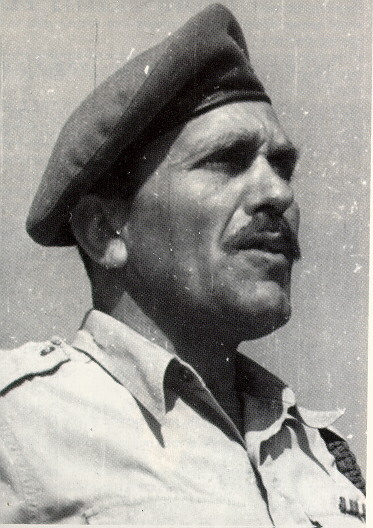
Imi Lichtenfeld, founder of Krav Maga.
To fully appreciate Krav Maga, David says, you need to know its history.
The origins of Krav Maga can be traced to pre-World War II Czechoslovakia (present-day Slovakia) and a young Jewish athlete named Imi Lichtenfeld. Imi was a nationally and internationally renowned boxer, wrestler, and gymnast. Beginning in the mid-1930s, fascist and anti-Semitic groups rose to power in Czechoslovakia and began inflicting violence on Jewish communities. Feeling duty-bound to protect his neighbors, Lichtenfeld organized a group of young men to patrol his community and defend against would-be attackers. He quickly learned, however, that his training in sport martial arts was no match for the anti-Semitic thugs he encountered. Fighting for points in a match and fighting for your life in a street fight require a different mindset and different techniques. To effectively defend himself and his community, Imi began synthesizing his martial art knowledge and started placing an emphasis on attacks that quickly disabled and neutralized a threat.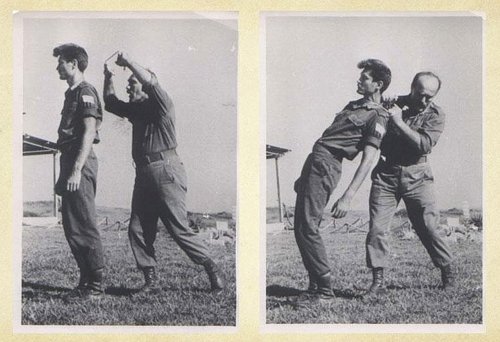
By 1940, Imi found himself living under a Nazi-allied puppet regime and decided to head for Palestine to join the Zionist Movement and fight for a Jewish state of Israel. When he moved to Palestine in 1942, he joined the Haganah, a pre-Israel Jewish paramilitary organization with a mission to protect Jewish settlers from locals who did not welcome the new arrivals. Israeli military leaders quickly noticed Imi’s fighting skills and his ability to teach those skills to others. They put him in charge of training the military’s elite fighting forces, including the Palmach (elite strike force), the Palyam (marine commandos), and the Haganah.
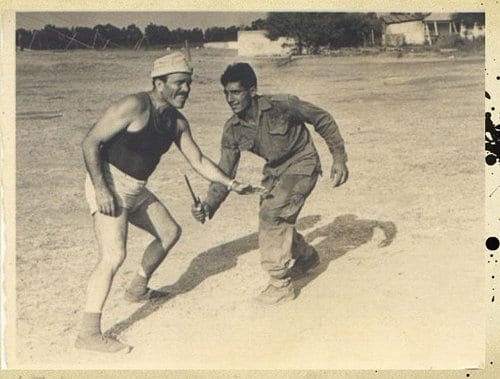
After Israel gained statehood in 1948, these separate fighting forces were merged into the Israel Defense Forces (IDF), and Lichtenfeld was named the Chief Instructor of Physical Fitness at the IDF School of Combat Fitness. It was in this role that he developed what today is known as Krav Maga. Lichtenfeld needed a combative system he could teach new military recruits in just three weeks — one that was simple, efficient, and effective, and could be applied in a number of lethal situations. To create such a system, Lichtenfeld combined the most effective techniques of boxing, aikido, judo, wrestling, and jujitsu into a single, fluid, fighting military discipline that emphasized continuous motion, simultaneous defense and attack, and attacks to an assailant’s soft tissue and pressure points. He called his self-defense system “Krav Maga,” meaning “contact combat” in Hebrew. It quickly became the official combative of the IDF and continues to be today.
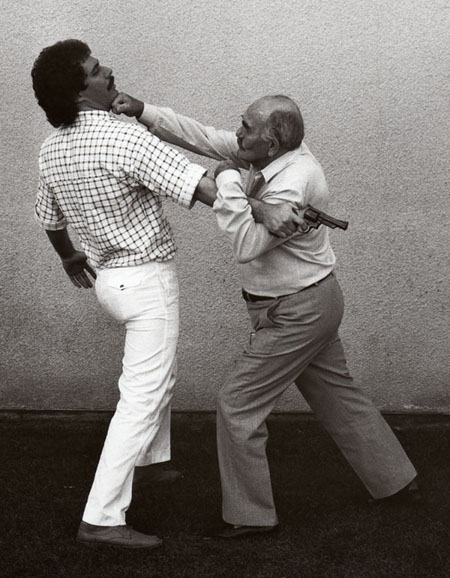
After retiring from the IDF, Lichtenfeld began teaching Krav Maga to Israeli citizens.
Imi taught Krav Maga for nearly 20 years in the IDF. After retiring from military service in 1964, he began devoting his time and energy to modifying and teaching the self-defense system to civilians. Imi opened two Krav Maga studios in Israel where he taught thousands of students and instructors, all while continuing to add and improve upon the fighting discipline he had developed in the military. In 1974, Imi founded the Krav Maga Association, a non-profit dedicated to promoting and teaching Krav Maga in Israel and throughout the world.
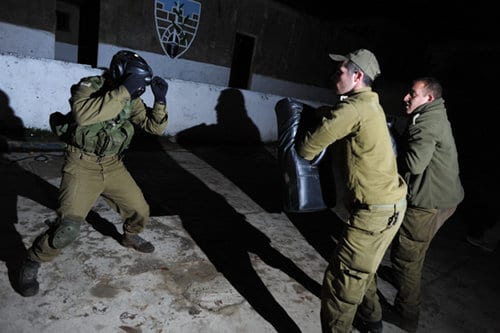
Krav Maga is still the official combative system of the Israeli Defense Forces.
A few of Imi’s early disciples brought Krav Maga to the United States, and it quickly became a preferred close-combat system in many U.S. military and police forces. Several commercial Krav Maga organizations have formed over the years to teach and promote Krav Maga in the U.S., each with a counterpart in Israel. Each of these organizations claim to be the “true” heir and guardian of Imi Lichtenfeld’s original Israeli Krav Maga, and go out of their way to show their connection to Krav’s founder.
The Principles of Krav Maga

As mentioned above, Krav Maga is a tactical mixed-martial art/combative and self-defense system that combines boxing, judo, jujitsu, and aikido. In recent years, other martial arts have been incorporated into Krav Maga such as muay Thai and Wing Chun.
Neutralize the threat. The primary goal in Krav Maga is to neutralize your threat as quickly as possible. This overarching goal governs all the other principles of Krav Maga. Because your aim is to dominate and incapacitate your attacker as soon as possible, pretty much anything goes in Krav Maga. You can’t worry about fighting etiquette when your life is on the line. You do whatever you have to do to preserve your life.
Keep it simple. There aren’t katas or patterns in Krav Maga. Just strikes, holds, and blocks. Krav Maga was designed so that it could be put to use as soon as possible.
Simultaneous defense and attack. Many martial arts treat defensive and offensive moves as separate and discrete actions, e.g., first you block (defensive), then you kick when you find an opening (offensive). The downside of this approach is that it’s reactive and you typically just end up in a cycle of never-ending defensive movements. In Krav Maga, the fighter looks to combine an offensive movement with every defensive movement — he wants to disrupt the attack and simultaneously counterattack. For example, if an attacker goes for your throat, you’d not only try to deflect his attack, but also simultaneously counterattack by going for his eyes, groin, or throat. The goal is to neutralize your threat as quickly as possible. (Sidenote: Wing Chun also has a similar simultaneous defensive/offensive principle.)
Retzev, or continuous motion. Related to the principles of simultaneous defense and attack is retzev, a Hebrew word for “continuous motion.” David Kahn describes retzev as a “seamless explosion of violence,” in which the goal is to neutralize your attacker with a continuous series of aggressive defensive and offensive movements. As your attacker reacts to your counterattacks, you’ll respond with more punches, kicks, and headbutts until the attacker is no longer a threat. Retzev requires a fighter to work from instinct and not rely on a pre-set routine. A well-trained practitioner of Krav Maga will know how to react to any type of threat without hesitation.

Use of weapons of opportunity. You can easily incorporate firearms and knives into Krav Maga. Besides these traditional weapons, Krav Maga also teaches practitioners to improvise and use any object at their disposal as a weapon. Keys, pens, belts, and chairs can all be incorporated into Krav Maga techniques in order to neutralize your opponent as quickly as possible.
Weapon defense. Besides teaching students how to use weapons, Krav Maga also shows how to defend yourself from an armed attack.
Focus on vulnerable soft tissue and pressure points. A well-known principle of Krav Maga is its emphasis on attacking vulnerable soft tissue and pressure points. Many counterattacks involve eye gouging, groin attacks, and strikes to the throat. Some criticize Krav Maga for this, arguing that “it’s not manly to punch a guy in the nuts.” I brought this criticism up with David during our conversation and this was his response: “Krav Maga’s goal is to neutralize a dangerous attacker as quickly as possible. Plain and simple. Sometimes a strike to the groin is the best option to neutralize an attack. When you’re violently attacked in the street, the person attacking you isn’t following some sportsman’s code of chivalry — he wants to hurt, maim, or possibly kill you — so why should you give him the courtesy of not punching below the belt? You can’t worry about fighting etiquette or what’s ‘manly’ when your life is at stake.”
Subduing techniques. In addition to striking attacks, Krav Maga also utilizes subduing techniques in order to de-escalate a violent confrontation. Joint locks and various grabs are used to exert control over your attacker and put you in a position to end the threat.
Krav Maga in Action
How to Get Started in Krav Maga
Join a Krav Maga gym. The best way to get started with Krav Maga is to join a Krav Maga gym. “Krav Maga, like any martial art, is best learned in a group and under the guidance of a well-trained instructor,” says David. Because Krav Maga is designed to prepare you for real-life attacks, you need to have people who can help simulate those situations for you in a gym. It’s hard to practice how to defend and counterattack a headlock if no one is there to put you in a headlock.
David did have one caveat about joining a Krav Maga gym. Because of Krav’s growing popularity in the United States, there are a lot martial arts studios saying they teach Krav Maga in order to get new students, even though the instructors sometimes have little or no formal training in the system. “Do your research and make sure the instructors are legit,” David says. If the instructor has trained in Israel, that’s a good sign.
As mentioned above, there are several competing Krav Maga organizations that claim to be teaching the “true” Krav Maga of Imi Lichtenfeld. It’s a touchy subject among Krav Maga followers and there have been lawsuits between the groups. David is the Chief Instructor of the U.S. Israeli Krav Maga Association (IKMA), a non-profit formed in 1978 by Imi Lichtenfeld to govern and promote the teaching of Krav Maga. There are gyms across the country that associate with U.S. IKMA. David teaches at the gym in New Jersey. If you’re in the area, stop by and check it out. David is a super nice guy and you’ll learn a lot.
Buy videos and books. If you can’t find a reputable Krav Maga gym in your area, there are plenty of instructional books and DVDs on the subject. Watching a DVD is definitely no substitute for actually training in a gym, and you shouldn’t try out moves you’ve learned solely by video in a street fight, but the DVDs will give a basic overview of Krav Maga and its techniques. I highly recommend David’s set of DVDs, Mastering Krav Maga. They’re very well-done and David does a great job explaining and demonstrating the methods and movements.
Related posts:
- Don Draper Judo: Unarmed Self-Defense from the Mad Men Era
- A Man’s Guide to the Martial Arts: Getting Started
- So You Want My Job: Martial Artist
- How To Throw a Dynamite Overhand Punch
- How to Use a Flashlight in a Tactical Situation