< G N Z S N Z >

Knock loud, I’m home.


Behind a Little House, 2008 from Behind a Little House series © Manuel Consento


Behind a Little House, 2008 from Behind a Little House series © Manuel Consento


Behind a Little House, 2008 from Behind a Little House series © Manuel Consento


Behind a Little House, 2008 from Behind a Little House series © Manuel Consento


Behind a Little House, 2008 from Behind a Little House series © Manuel Consento


Behind a Little House, 2008 from Behind a Little House series © Manuel Consento

Knock loud, I’m home.

Clarity

Photo


Crowd Control

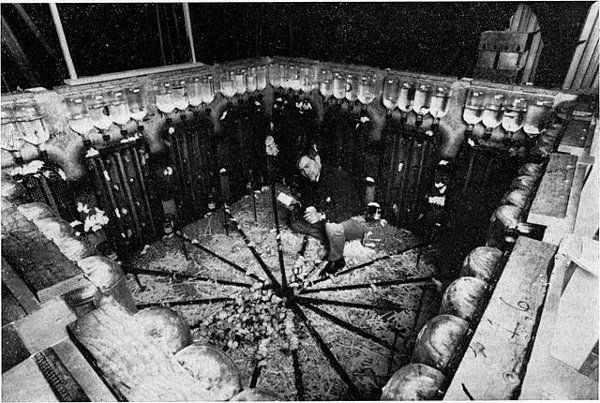
http://commons.wikimedia.org/wiki/File:CalhounJ.JPG

In July 1968, ethologist John B. Calhoun built a “mouse utopia,” a metal enclosure 9 feet square with unlimited food, water, and nesting material. He introduced four pairs of mice, and within a year they had multiplied to 620. But after that the society began to fall apart — males became aggressive, females began neglecting their young, and the weaker mice were crowded to the center of the pen, where resources were scarce. After 600 days the females stopped reproducing and the males withdrew from them entirely, and by January 1973 the whole colony was dead. Even when the population had returned to its former levels, the mice’s behavior had remained permanently changed.

There were no predators in the mouse universe; the only adversity was confinement itself. Calhoun felt that his experiment held lessons as to the potential dangers of human overpopulation, and he urged his colleagues to study the effects of high population density on human behavior. “Our success in being human has so far derived from our honoring deviance more than tradition,” he said. “Now we must search diligently for those creative deviants from which, alone, will come the conceptualization of an evolutionary designing process. This can assure us an open-ended future toward whose realization we can participate.”

(Thanks, Pål.)

Hong Kong's Kai Tak Airport

Kai Tak Airport was the international airport in Hong Kong from 1925 until 1998. The city had little available space, so the runway was built on reclaimed land out over Kowloon Bay. As Hong Kong grew during the 20th century, tall buildings went up dangerously close to the airport, and air traffic grew exponentially. In later years, Kai Tak was ranked as the sixth most dangerous airport in the world. It has since been replaced by the new and bigger Hong Kong International Airport to the west of the city.    

I flew in and out of Kai Tak airport (twice) in June of 1998, just days before the airport closed for good. No one prepared me for the terrifying landing. I went from pure excitement over being in Hong Kong to HOLY SH…. as the plane appeared to weave between skyscrapers and then land on a runway that looked to be inches from the sea on either side.

The Daily Mail has a collection of scary photographs of Kai Tak landings, taken by English teacher Daryl Scott Chapman, who lives in Hong Kong. Link -via Digg

(Image credit: Daryl Scott Chapman/HotSpot Media)

Remembering STS-135, the final Space Shuttle launch, 2 years ago today

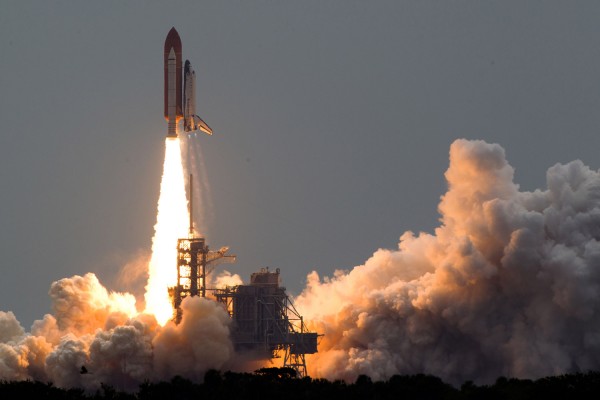
Space shuttle Atlantis launches for the STS-135 mission to the International Space Station in the final mission of the Space Shuttle Program at NASA's Kennedy Space Center in Florida. Liftoff was at 11:29 a.m. (EDT) on July 8, 2011. Onboard were NASA astronauts Chris Ferguson, STS-135 commander; Doug Hurley, pilot; Sandy Magnus and Rex Walheim, both mission specialists. Photo credit: NASA Photo/Houston Chronicle, Smiley N. Pool

Space fans around the world today mark a bittersweet milestone: two years since the final Space Shuttle launch, STS-135, on July 8, 2011.

I was there watching Miles O'Brien and the SpaceFlight Now live webcast crew do their thing. Like everyone who was fortunate enough to be there that day, I'll never forget it. Even the snapshots I Flickr'd that day make me tear up. The rocket boosters' red glare, the sonic booms bursting in air, gave proof through the night that our space program was still there. Of course, America still has a space program, but things have changed.

Atlantis and her crew landed safely on July 21, 2011, and you can see her at KSC in a beautiful new exhibit.

But it's sad to think back on those glorious shuttle launches and know they'll never happen again. For so many people, they were like seasons with which to mark the unfolding of one's own life.

Perhaps no one feels that loss as closely as the space laborers Miles O'Brien lovingly referred to as "The Shuttle Shokunin."

Above: Miles O'Brien covered more than 40 space shuttle launches. He led CNN's coverage of the loss of space shuttle, Columbia, and co-anchored astronaut John Glenn's return-to-space mission with television news legend Walter Cronkite. Just before the final liftoff, he reported to PBS NewsHour on "Shuttle ennui." I remember the day we shot this, in the back yard of the Inn at Cocoa Beach, which is near Cape Canaveral. It's one of many Florida towns where the local economy was wrecked after the shuttle program ended.

Below, Miles on what the end of the shuttle program meant for Florida and where the program fell short.

Video from cameras mounted on the two solid rocket boosters that helped propel space shuttle Atlantis into orbit on July 8, the last shuttle mission in US space history. Video shows launch from Kennedy Space Center, and the rocket boosters' subsequent water landing downrange in the Atlantic Ocean.


La órbita de Phobos, vista por Curiosity

La NASA ha publicado un vídeo en el que se puede ver la órbita de Phobos, una de las dos lunas de Marte. El vídeo se ha realizado gracias a las imágenes tomadas por Curiosity, que en su día 317 sobre la superficie marciana apuntó su cámara de navegación (Navcam) al cielo durante unos 27 minutos. Durante ese tiempo se capturaron 86 frames, que después se combinaron y se aceleraron para crear este efecto.


Burned out.

Photo


I read the news today oh, boy

< G N Z S N Z >